As of March 1st, 2010, Google has dropped support for Microsoft longest standing web browser, the IE6. Meaning that Google docs, Google Apps, Gmail and all other Google services will no longer support the ageing browser in an effort to introduce new features to these services.
Archive for the ‘IT News’ Category
No more Internet Explorer 6
Saturday, March 6th, 2010FireFox 3.6 is finally here
Friday, January 22nd, 2010Firefox 3.6 has finally landed. Now you can try the latest web browser from Mozilla. The new version comes with some new features: speed, detection of outdated plugins and graphics personas. Most important feature of all is the added securities that makes it the safest browser to use.
You can try it for yourself after you download it from here : www.getfirefox.com
IE vulnerability exploit code released on the Internet
Saturday, January 16th, 2010Exploit code for the zero-day hole in Internet Explorer linked to the China-based attacks on Google and other companies has been released on the Internet, Microsoft and McAfee warned on Friday.
Meanwhile, the German federal security agency issued a statement on Friday urging its citizens to use an alternative browser to IE until a patch arrives.
More on this issue here.
iFolder 3.8 is out.
Monday, December 7th, 2009iFolder 3.8 is out. Download it from here http://sourceforge.net/projects/ifolder/files/.
HP to acquire 3Com Corporation
Thursday, November 26th, 2009On November 11, 2009, HP and 3Com Corporation announced that they signed a definitive agreement for HP to acquire 3Com, a leading provider of networking switching, routing, and security solutions. The acquisition would create an innovative, networking leader that will transform the networking industry with a global reach.
The acquisition would create a robust set of end-to-end networking solutions in a $40B market. It would combine HP ProCurve networking strengths in the LAN edge with 3Com strengths in Core switching. 3Com would also offer the opportunity to add a leading security offering with its TippingPoint business.
The combination of HP and 3Com would offer customers a superior networking alternative. Together, the combined businesses would provide customers with a comprehensive set of enterprise-class solutions based on open, industry standards and innovative technology that simplifies the network, delivers best-in-class price-performance, and improves IT service delivery capabilities.
With the addition of 3Com, HP expects to become the #2 enterprise networking vendor worldwide and significantly strengthens HP’s position in one of the fastest-growing markets in the world, China. HP also plans to build upon 3Com’s presence in China to fuel continued innovation.
The enhanced networking solutions would leverage the capabilities of the largest technology company in the world (#1 in servers, #1 in storage) and its global reach (extensive worldwide customer relationships, 154,000 partners) to deliver better business outcomes to the full spectrum of customers, from Fortune 100 enterprises to small businesses.
The acquisition is expected to close in the first half of calendar year 2010.
Customer value
With the addition of 3Com, HP would deliver a comprehensive and innovative set of enterprise-class networking solutions that simplify the network, drive best-in-class price-performance at the lowest total cost of ownership, and transform the network from a connectivity tool to a business enabler.
HP, with a focus on purposeful innovation based on open, industry standards, enables customers to break free from the limitations imposed by expensive, rigid, and proprietary networking infrastructure. This not only reduces acquisition and operations costs but also creates flexibility for customers to deploy best-in-class solutions—which include market-leading partners.
The enhanced networking solutions would further accelerate HP’s next generation data center architecture strategy, the HP Converged Infrastructure architecture. Underpinned by the robust, end-to-end HP networking offerings, the HP Converged Infrastructure helps customers rebalance their innovation-operations/maintenance ratio, makes adminstrators more productive, enables faster time to value, improves service levels, and increases capacity utilization, all leading to an IT environment that adapts to the most demanding needs and delivers better business outcomes.
Web Browser Market Share Report
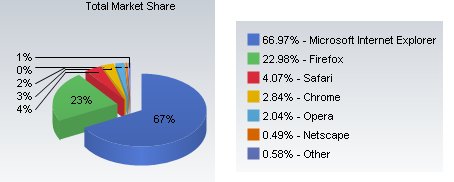
Tuesday, September 15th, 2009According to market research firm Net Applications, Internet Explorer had roughly 67 percent of the worldwide browser market in August, while the Mozilla foundation’s Firefox had 23 percent and Apple Inc’s Safari browser had 4 percent. This was true on Aug 2009.

Firefox 3.5.2 Released
Saturday, August 15th, 2009Mozilla Foundation released the latest version of the well known web browser, Firefox 3.5.2. The new version addresses several critical security vulnerabilities. Among the stability improvements, it also brings proper ICC profiles rendering. Private browsing mode is included along with open video format support already built in.

To test the new open video format support in Firefox, check out : http://openvideo.dailymotion.com/en
EUROPA: Commission welcomes new Microsoft proposals on Microsoft Internet Explorer and Interoperability
Saturday, July 25th, 2009Printronix and TallyGenicom AG Reach Final Agreement in Europe and Worldwide
Sunday, July 19th, 2009Under Terms, Printronix Will Acquire From TallyGenicom AG Intellectual Property and Sales Distribution Rights for All TallyGenicom Line Matrix and Laser Printer, Supplies and Consumables Business While TallyGenicom AG Retains All Intellectual Property and Worldwide Sales Distribution Rights for Serial Matrix, Inkjet and Thermal Printers, Supplies and Consumables Business.
Under the terms of the agreement, Printronix will acquire intellectual property from TallyGenicom AG as well as worldwide sales distribution rights for all TallyGenicom line matrix and laser technologies, including printers, supplies and consumables. The acquisition is subject to regulatory approval. In addition, TallyGenicom AG retains all intellectual property and worldwide distribution rights for the TallyGenicom serial-matrix, inkjet and thermal technologies, which includes printers and options, supplies and consumables. TallyGenicom AG will continue to resell TallyGenicom-branded line matrix and laser products purchased from Printronix, and Printronix will resell serial matrix products purchased from TallyGenicom AG.
The companies entered into this agreement after TallyGenicom lodged objections to Printronix’s March 23, 2009 acquisition of certain assets of TallyGenicom LP, as prescribed by the U.S. Bankruptcy Court for the District of Delaware. Today’s announcement resolves all disputes between Printronix and TallyGenicom AG.
Distributors, resellers and end-user customers of TallyGenicom-branded products can purchase products from their existing TallyGenicom reseller or by contacting Printronix’s global sales offices:
— United States: +1 800-665-6210
— Europe, Middle East, & Africa: +33 (0) 1 46 25 19 00
Customers wishing to contact TallyGenicom AG may call +49 (0) 731 20 75 0
Toshiba launches Blu-ray after DVD setback
Sunday, July 19th, 2009Japan’s Toshiba Corp. will enter the Blu-ray DVD market, more than a year after it gave up on its own next-generation format that failed to gain industry support, a report said.
The media-electronics conglomerate will launch Blu-ray products as early as this year, a complete reversal of its position over the high-density DVD standard, the Yomiuri Shimbun newspaper said.
Toshiba had promoted its “HD DVD format”, pitting itself against the Blu-ray system developed by Sony and its partners, in a competition characterised as a re-run of the VHS-Betamax battle in video cassette tapes in the late 1970s.
Major Hollywood studios with vast movie back catalogues sided with Blu-ray, which then dominated the key Japanese market.
The move pushed Toshiba to concede defeat and give up on promoting HD DVD in early 2008, in an echo of Sony’s Betamax setback a generation ago.